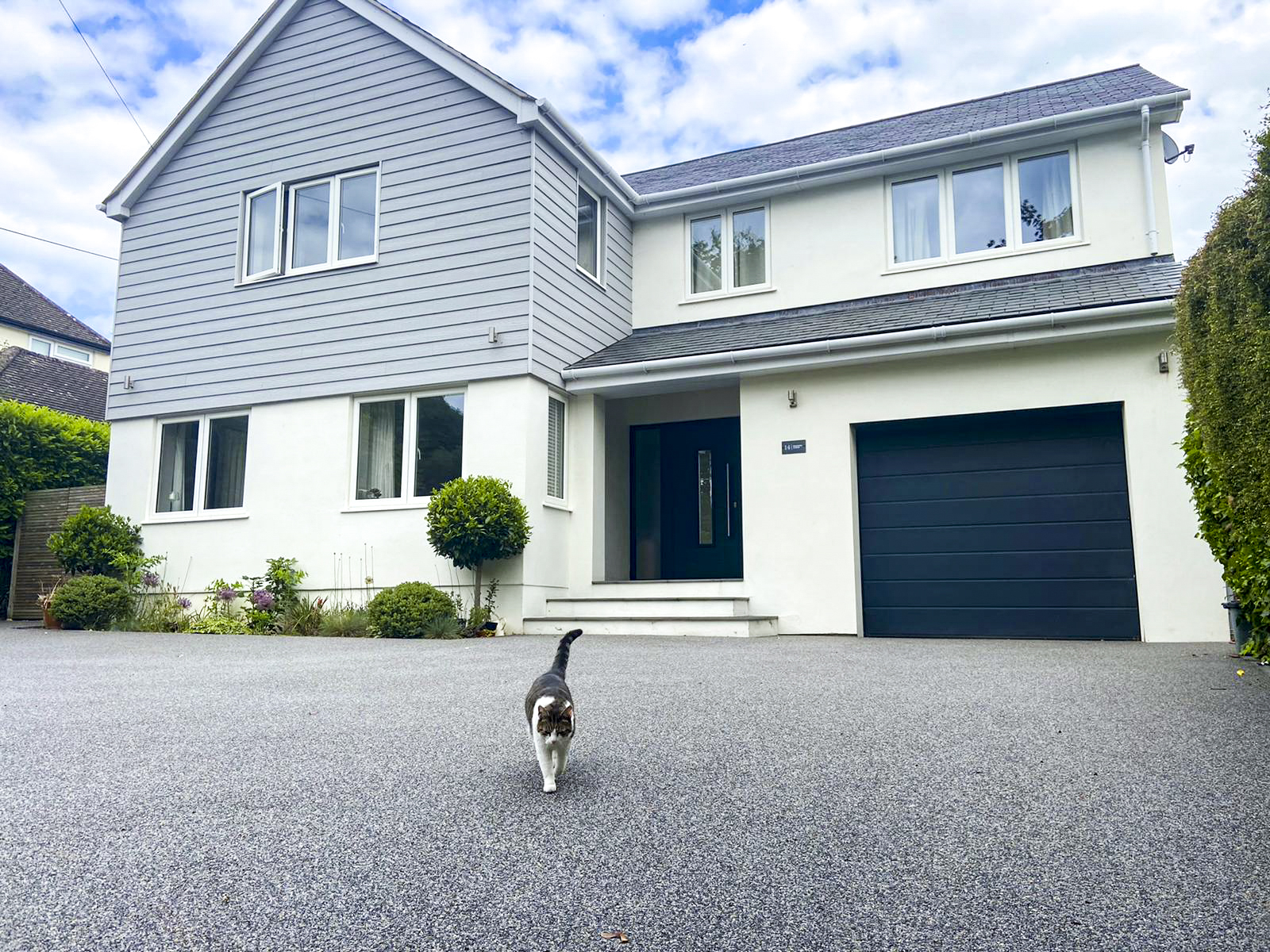
Resin bound driveways cost £60–£95 per m² fully installed across the UK in 2026, with a total project range of £1,800–£9,000. A typical 40–50m² driveway lands at £3,500–£5,000. Those are the figures to plan around when you're researching how much does a resin bound driveway cost UK — but the per-m² rate alone won't tell you what you'll actually pay.
We've been pricing and installing resin bound surfaces across Essex for over 30 years. This guide covers what moves a quote up or down: base conditions, SuDS planning rules, the true lifetime cost of ownership, what separates a professional installation from a DIY kit, and the red flags that point to a rogue trader. No filler.
How Much Does a Resin Bound Driveway Cost in the UK?
The headline rate is £60–£95 per m², fully installed. Size is the biggest single driver of total cost. A small single driveway of around 20m² typically runs £1,800–£2,400. A standard single at 30–40m² comes in at £2,500–£3,800. A double at 50–60m² sits in the £3,500–£5,500 range.
All of those figures assume a sound, level existing tarmac or concrete base. Removal, groundwork, and drainage are priced separately — the dedicated sections below cover each.
One thing to watch with older quotes: resin and aggregate material costs rose 8–12% between 2022 and 2024 due to supply chain pressures. Any guide still quoting £40–£55/m² as current pricing is working from pre-inflation data. That's not what contractors are actually charging in 2026.
Resin Bound Driveway Cost by Size
| Project Size | Area | Typical Installed Cost | Typical Duration |
|---|---|---|---|
| Small / path area | Up to 20m² | £1,200–£2,000 | 1 day |
| Single car driveway | 30–40m² | £2,500–£3,800 | 1–2 days |
| Double car driveway | 50–60m² | £3,500–£5,500 | 2–3 days |
| Large driveway | 80–100m² | £5,500–£9,000 | 3–5 days |
Per-m² rates fall as the project grows. A larger pour reduces labour mobilisation costs relative to area and cuts proportional material wastage — so a 100m² project prices closer to £60–£70/m², while a 20m² job sits toward £80–£95/m².
All figures above assume standard Cotswold buff aggregate at 16–18mm installation depth on an existing sound base. Commercial projects — car parks, retail forecourts, housing developments — are priced on a bespoke basis with volume rates negotiated directly.
Resin Bound vs Resin Bonded: Cost and Key Differences
These two surfaces get confused constantly. The distinction has real financial and legal consequences.
Resin bound: Aggregate stones are fully encapsulated in resin before laying. The resulting surface is UV-stable, permanently permeable, and stones cannot shed. This is the premium specification. Typical installed cost: £60–£95/m².
Resin bonded: Liquid resin is applied to the base first, then aggregate is scattered on top and pressed in. The surface is not permeable. Surface stones can shed over time — particularly under vehicle turning. Cheaper upfront at £30–£50/m², but the lifetime cost is higher.
The permeability difference has a direct legal consequence, covered fully in the planning section below. Short version: resin bound typically requires no planning permission for front driveways; resin bonded does.
Over a 15–20 year horizon, the lower upfront cost of resin bonded is routinely eroded by recoating, patching, and eventual full replacement. Resin bound is usually the better financial decision — not just the better-looking one.
BBA (British Board of Agrément) certification exists for resin bound systems and is the industry quality benchmark. No equivalent applies to resin bonded.
What Affects the Cost of a Resin Bound Driveway?
Six variables move a quote up or down. Understanding each one lets you compare quotes on a genuine like-for-like basis.
Condition and Type of Existing Base
Resin bound can go directly over a sound, flat tarmac or concrete surface. Solid base means no excavation, lower cost. A cracked, sunken, or contaminated base requires a full dig-out and a new MOT Type 3 permeable sub-base — typically adding £20–£40/m² to the total.
One detail that catches homeowners out: the sub-base must itself be permeable to maintain the surface's SuDS compliance. A concrete sub-base beneath resin bound undermines its drainage credentials and, in some interpretations, its permitted development status. An experienced installer will flag this at survey. An inexperienced one won't.
Aggregate Specification and Resin Grade
Standard 2–5mm Cotswold buff or golden gravel is the most widely available and affordable aggregate. Decorative blends — marble, slate, rose quartz, multi-tone mixes — add £5–£15/m² depending on specification.
UV-stable, BBA-certified resin is the minimum specification for a warranty-backed installation. Cheaper uncertified resins yellow and embrittle within 3–5 years. The material saving is real in year one. The cost of failure in years three to five is considerably higher.
Installation depth affects material volume too. Residential driveways require 16–18mm. Pedestrian paths can use 12–14mm at a lower material cost per m².
Design Complexity and Edging
Straight rectangular driveways are the most cost-efficient to lay. Curves, inlaid borders, contrasting colour bands, and pattern work all add labour time and material. Aluminium or resin-composite edge restraints are required at all perimeters to contain the pour — decorative kerb upgrades or bullnose edging can add £200–£600 to a mid-size project.
Multiple aggregate colours or inlaid logos attract a design and laying premium of 15–25% on the base rate. Common on commercial sites and prestige residential work.
Location and Regional Labour Rates
London and the South East — Essex included — sit toward the top of national rate ranges. Expect quotes toward £75–£95/m² in this region. Northern England, the Midlands, Scotland, and Wales typically run 10–20% lower on labour, with £60–£75/m² more common.
Access constraints add time and cost. Narrow side gates, steep gradients, significant distance between mixer and laying area, restricted parking for plant — any of these will appear in an accurate quote. They should appear in yours.
Labour vs Materials: Where Your Money Goes
On a typical mid-range project, materials — resin, aggregate, edging channels, geotextile membrane — account for roughly 50–60% of total cost. Skilled labour is 40–50%.
To put numbers on it: a £4,200 double driveway breaks down to approximately £2,100–£2,500 in materials and £1,700–£2,100 in labour.
Machine mixing using a forced-action mixer — not a standard drum mixer — is the only method that achieves the homogenous, BBA-compliant finish a durable surface requires. It's also one of the most reliable indicators of a professional installer when you visit an active job or watch reference footage.
Labour cost is not a margin to cut. Rushed or under-resourced crews produce thin spots, poor edge finish, and premature failure. That 40% component exists for good reason.
Removal of Existing Surface and Groundwork Costs
Removing old tarmac or concrete typically costs £5–£15/m² as a discrete line item. This is frequently buried in groundwork totals in competitor quotes — ask any contractor to break it out explicitly so you can compare on equal terms.
Block paving removal is more labour-intensive due to individual units and mortar beds. Expect £8–£20/m².
Skip hire for spoil and rubble runs £200–£450 per skip depending on size and location. Most driveways generate one to two skips.
If the existing surface is sound and level, it can often stay in place as a base — eliminating removal cost entirely. A site assessment is the only way to determine this accurately. A phone call isn't.
New permeable sub-base (MOT Type 3, typically 100–150mm compacted depth) costs £15–£35/m² to supply and install if required.
Extra Costs to Budget For
Several items appear on many projects and are worth factoring in before you request quotes.
Drainage channels or interceptor gullies run £150–£600 depending on run length and product specification. Steps or raised edging between driveway and garden cost £80–£200 per linear metre in resin-finished concrete or natural stone. A dropped kerb, if not already in place, typically runs £500–£1,500 via the local highway authority — required for any new vehicle crossover from a public road. Line markings or tactile paving on commercial schemes are priced per linear metre.
On VAT: most VAT-registered contractors charge 20%. Always confirm whether quotes are inclusive or exclusive. A quote that looks cheaper ex-VAT often isn't once you add it back.
DIY Resin Bound Kits vs Professional Installation
DIY kits are available at £30–£50/m² in materials. For a 30m² driveway, that's a potential saving of £800–£1,500 on paper versus a professional quote.
The practical reality is more complicated. Forced-action mixer rental runs £80–£120 per day. Aggregate must be pre-dried — damp stone causes bubbling and delamination. Resin-to-aggregate ratios must be precise, and working time is fast. These are learnable skills. They're not beginner-friendly ones.
BBA certification — required by many mortgage lenders and increasingly expected by conveyancers on property sale — is only valid for professionally installed systems using certified products. A DIY installation, however well executed, won't carry this certification.
A failed DIY installation almost always requires full excavation before a professional can re-lay. That turns a cost saving into an additional expense: original materials, skip hire, and full professional installation layered on top.
DIY resin is viable for experienced hands on small paths under 15m². For driveways, professional installation is almost always the better financial decision over a 10-year horizon.
Planning Permission and SuDS Rules Explained
This matters more than most guides admit.
Under permitted development rules, any new hard-standing on a front garden over 5m² requires planning permission — unless the surface allows rainwater to drain through it. This derives from the Town and Country Planning Act 1990 as amended in 2008, and it directly determines which driveway surface you can legally install without an application.
Resin bound is permeable by design. Water drains through the aggregate voids into the permeable sub-base below. It qualifies as permitted development in most cases — no planning application, no £258 fee (England, 2025 fee revision), no eight-week wait.
Resin bonded is not permeable and therefore requires planning permission for front driveways over 5m². Many homeowners only discover this after committing to the lower price — at which point they face either a retrospective application or a non-compliant installation.
SuDS policy is tightening further. New developments and extensions in England increasingly require permeable surfaces as a planning condition. Resin bound future-proofs your property against those rules.
Conservation areas, listed buildings, and Article 4 Direction areas may restrict permitted development rights regardless of surface type. Check with your local planning authority if your property falls into any of those categories.
The planning-permission-free status of resin bound isn't a minor footnote. It's a genuine financial and legal advantage — and it rarely gets explained clearly in competing guides.
Long-Term Cost of Ownership Over 10–25 Years
A BBA-certified resin bound driveway on a proper permeable sub-base has an expected lifespan of 15–25 years with minimal maintenance. Occasional jet washing and weed spot-treatment are the practical reality. No sealing, no recoating, nothing structural.
Typical annual maintenance spend: £0–£50 DIY; professional deep clean £100–£200 every two to three years.
Localised repairs — isolated cracks, vehicle oil damage — cost approximately £150–£400. Well short of full resurfacing.
Estimated 20-year cost of ownership:
| Surface | Installation | Maintenance & Repairs | Replacement | 20-Year Total |
|---|---|---|---|---|
| Resin bound | £4,500 avg | £500–£1,500 | None expected | ~£5,000–£6,000 |
| Resin bonded | £2,500 avg | £1,500–£3,000 | ~£2,500–£4,000 | ~£6,500–£9,500 |
| Tarmac | £2,500 avg | £1,500–£3,000 (reseals) | ~£2,000–£3,500 | ~£6,000–£9,000 |
| Block paving | £5,000 avg | £2,000–£4,000 (repointing) | N/A | ~£7,000–£9,000 |
Resin bound outperforms every common alternative on lifetime cost for most homeowners. The upfront price premium typically disappears by year eight to ten.
Does a Resin Bound Driveway Add Value to Your Home?
Estate agents consistently rank kerb appeal and off-street parking among the highest-return exterior improvements. A premium resin driveway delivers both in a single project.
Properties with off-street parking command an average premium of 5–10% over comparable properties without it in urban and suburban areas. That premium is particularly pronounced in Essex commuter towns, where street parking is under real pressure.
A written 10–15 year warranty from an established, traceable installer is increasingly expected by conveyancers on sale. Valuers look favourably on low-maintenance, warranted surfaces with demonstrable longevity and proper drainage compliance.
For commercial and HMO landlords, a smart forecourt reduces maintenance liability and supports premium rental positioning. A tangible return on the additional upfront spend.
Red Flags: How to Avoid Rogue Resin Driveway Traders
The resin driveway sector attracts a disproportionate share of rogue traders. These are the warning signs we'd tell a family member to watch for.
Cash-only requests with no paper trail. A legitimate contractor invoices via bank transfer or card. Cash-only is the single most reliable indicator of a rogue trader.
No written warranty, or an unverifiable one. Ask for the warranty document before signing. Any credible installer produces it in 30 seconds. Evasion is an answer.
Unable to name or verify the resin system. Ask for the product datasheet and BBA certificate number. Legitimate products are verifiable on the BBA website in under a minute.
Quotes below £45/m² fully installed. Almost always means a thin resin layer, uncertified materials, or a base that won't be properly prepared. The low price exists for a reason — you'll pay the rest in repairs.
No verifiable public liability or employers' liability insurance. Request certificates. Check Companies House registration. Walk away if either is unavailable or the company can't be traced.
High-pressure same-day pricing or unsolicited door-to-door visits. Established contractors with full order books don't pressure-sell on the doorstep.
No references from projects completed 2–3 years ago. Surface failures from thin resin or poor base preparation typically become visible within 18 months. Ask for older jobs specifically. Visit them if you can.
How to Get an Accurate Resin Driveway Quote
Get at least three quotes from established local contractors. Compare on a genuine like-for-like basis: same resin system brand and BBA certificate number, same aggregate size, same installation depth, same sub-base specification, same warranty terms.
Measure your driveway before any calls begin — length × width = m² — so you can cross-check quoted areas and sense-check per-m² figures against the ranges in this guide.
Insist on a site visit before any price is confirmed. Access, drainage, base condition, and ground levels can't be assessed remotely. A quote issued without a site visit isn't a quote. It's a guess with a number attached.
Ask each contractor for a written, line-by-line breakdown separating materials, labour, removal, and groundwork. Any contractor unwilling to provide this should be treated with caution.
We offer free, no-obligation site surveys across Essex and surrounding areas. Over 30 years and 1,500+ completed jobs inform every assessment we carry out — and every quote we issue is fully itemised in writing.
FAQ
How much does a resin bound driveway cost per square metre in the UK?
Resin bound driveways cost £60–£95 per m² fully installed in the UK in 2026, with the South East and London toward the higher end. A standard single driveway of 30–40m² typically comes to £2,500–£3,800; a double at 50–60m² runs £3,500–£5,500. These figures assume a sound existing base — groundwork and removal are additional.
Is a resin bound driveway worth the money?
For most homeowners, yes — particularly over a 10-year-plus horizon. The upfront cost is higher than tarmac or resin bonded, but lower maintenance, no recoating requirement, and an expected 15–25 year lifespan mean lifetime ownership costs typically come in below cheaper alternatives. The kerb appeal uplift and off-street parking premium reinforce the value case.
How long does a resin bound driveway last?
A professionally installed, BBA-certified resin bound driveway on a proper permeable sub-base typically lasts 15–25 years. Longevity depends primarily on sub-base preparation, installation depth (16–18mm minimum for driveways), and resin quality. Cheap uncertified systems installed thin can begin to fail within 3–5 years.
What is the difference between resin bound and resin bonded driveways?
Resin bound fully encapsulates aggregate stones in resin before laying — the result is permanently permeable and stones can't shed. Resin bonded applies resin to the base first, then scatters aggregate on top — the surface isn't permeable and stones can shed over time. Resin bound costs more upfront (£60–£95/m² vs £30–£50/m²) but is superior in durability, appearance, and legal compliance.
Does a resin bound driveway add value to your home?
Yes. Off-street parking adds an estimated 5–10% premium to property values in urban and suburban areas, and a high-quality resin bound surface improves both kerb appeal and perceived maintenance standards. A written long-term warranty from a traceable installer is increasingly expected by conveyancers, which smooths the sale process.
Do I need planning permission for a resin bound driveway in the UK?
In most cases, no. Under permitted development rules, front driveways over 5m² are exempt from planning permission if the surface is permeable — and resin bound is permeable by design. Resin bonded is not permeable and does require planning permission for front driveways over 5m². Conservation areas and listed buildings may carry additional restrictions; check with your local planning authority if in doubt.